
Berberine: The Natural Metabolic Master Switch for Diabetes and Obesity Treatment
Berberine: The Golden Compound Hidden in Nature
Berberine is a bioactive chemical that has recently gained popularity in the health industry, but its origins go back a long way. It is an isoquinoline alkaloid with a distinctive brilliant yellow colour and a notoriously bitter flavour. While modern science is only now catching up with its potential, traditional healers in China and India have used this potent chemical for hundreds of years. It was once used to treat infections and intestinal problems, but we now know it as a powerful metabolic regulator.
You might question where this chemical comes from. Berberine is extracted from a range of plants, rather than a single plant. The most frequent natural sources are goldenseal, Oregon grape, barberry, and Chinese goldthread. The component is usually contained in the roots, rhizomes, and bark of various plants. When you see a supplement on the shelf, it is actually a pure alkaloid taken from these botanical sources. Supplements contain a variety of salts, including berberine hydrochloride and sulphate, but the bioactive core stays consistent.
Berberine Mechanism: How It Decodes Your Metabolism
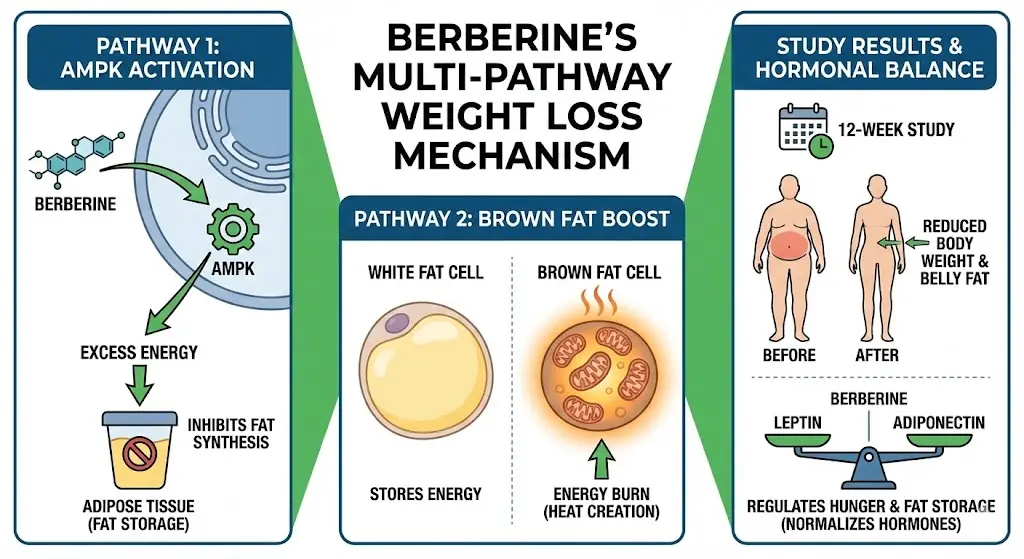
To understand why this molecule is so effective, we must examine what occurs within your cells. Berberine functions primarily by activating the enzyme AMP-activated protein kinase, or AMPK. Scientists frequently refer to AMPK as the metabolic master switch of the body. Consider it an internal sensor that checks energy levels. When you flip this switch on, your body stops accumulating fat and begins burning energy.
The activation of AMPK has a cascade effect throughout the body. It promotes the transfer of glucose from your blood to your cells, where it may be used for energy. This is comparable to how exercise operates at the cellular level. Furthermore, it improves the function of mitochondria, your cells’ power plants. When your mitochondria function properly, your total metabolism increases, and you feel more energized. This process differs from many pharmaceutical treatments in that it uses the natural energy routes of your body rather than forcing a specific chemical reaction.
Berberine: Research studies & Clinical Trials
The scientific world is extremely interested in Berberine since its effects are observable and significant. One of the most interesting aspects of research is its potential to replicate the effects of calorie restriction. When you fast or restrict calories, your body goes through positive healing processes. According to studies, berberine can stimulate comparable pathways, providing longevity advantages without the hardship of hunger.
Another notable part of the study is its effect on intestinal health. Recent research suggests that because berberine is poorly absorbed in the intestines, high quantities persist in the gut and potentially influence the gut microbiome (the bacterial community of your gut). It appears to decrease the number of dangerous bacteria while increasing the growth of helpful strains that produce short-chain fatty acids. This gut-modulating effect may help to explain its potent impact on metabolic illnesses, as we now know that gut health is intricately related to systemic inflammation and insulin sensitivity.
Berberine for Weight Loss: Turning Fat into Fuel
Many people use berberine v to help them lose weight, and research backs up this claim. It promotes weight loss through several routes.
- First, by activating AMPK, it suppresses fat production. It basically tells your body that it doesn’t need to store surplus energy as adipose tissue.
- Second, it appears to increase the activity of brown fat. Unlike white fat, which stores energy, brown fat burns it to generate heat. Increasing brown fat activity is a key factor in weight reduction study .
- Another method involves the hormones leptin and adiponectin. These hormones control appetite and fat storage. According to research, Berberine helps normalize these hormones, which may reduce cravings and make it simpler to stick to a balanced diet.
A recent clinical study published in the journal Phytomedicine examined obese people who took Berberine for twelve weeks. The findings revealed a considerable drop in body weight and a fall in body mass index. Participants decreased abdominal fat, which is the most hazardous type of fat linked to heart disease.
Berberine in Type 2 Diabetes: A Natural Rival to Metformin
Perhaps the most groundbreaking research involves the use of Berberine to treat Type 2 Diabetes. The syndrome is distinguished by elevated blood sugar levels and insulin resistance. Metformin is commonly used as the conventional pharmacological treatment. Interestingly, multiple clinical investigations have directly compared Berberine to Metformin and discovered that they have equivalent efficiency in decreasing blood glucose levels.
It works by improving insulin sensitivity. This implies it improves how well your cells respond to the insulin produced by your pancreas. It also inhibits the breakdown of carbs in the intestines and lowers sugar synthesis in the liver.
A pilot study published in the journal Metabolism found that diabetic patients who used this supplement experienced significant decreases in fasting blood sugar, post-meal blood sugar, and HbA1c levels. This evidence is extremely promising for anyone seeking a natural alternative or as a complement to traditional therapy.
However, anyone taking medicine should check their doctor because the combination can cause blood sugar to drop too low.
Berberine Supplementation: Forms and Bioavailability
One of the biggest issues with this chemical is its limited bioavailability. This means that just a small percentage of the capsule’s contents enter your bloodstream. The liver and gut wall are highly effective at filtering it out. Because of this, the type of supplement you choose is quite important.
Berberine Hydrochloride (HCl) is the most often used version in research and on the household. This form is reliable and has been used in the vast majority of successful clinical trials.
Newer formulations are seeking to address the absorption issue. You might come across phrases like Phytosome or Dihydroberberine.
- Phytosome technology links the alkaloid to a phospholipid complex, allowing it to pass through cell membranes more easily.
- Dihydroberberine is a reduced version that the body absorbs more easily and then converts back into the active form once in the blood.
While these newer formulations show promise for improved absorption, the HCl version remains the gold standard for established efficacy in clinical studies.
Berberine Dosage: How Much and When
The dosage utilized in most successful clinical trials is very consistent. The normal treatment consists of taking 500 mg three times a day for a total of 1500 mg per day. This divided dosage is critical because Berberine has a short half-life. It only lingers in your system for a few hours, so you must refill it throughout the day to keep blood levels normal. Taking the entire 1500 mg at once may cause gastric distress and is less helpful for metabolic balance.
Berberine Best Time to Take: Timing Matters
The optimal time to take your dose is about 20-30 minutes before a meal. This timing allows the chemical to enter your system precisely when your blood sugar and insulin levels would normally rise in response to eating. It permits the alkaloid to reduce the glucose rise and help your body metabolise the meal more effectively. If you forget to take it before eating, you can take it with the meal or just after, but the pre-meal window is best for metabolic regulation.
You should also consider the duration of use. While the supplement is safe to use long-term, several doctors advocate cycling it. A popular technique is to take it for eight to twelve weeks, followed by a two to four-week rest period. This stops the body from over-adapting to the chemical and allows you to examine how your body performs in its absence. Furthermore, because the compound is antimicrobial, it prevents long-term disruption of your gut microbiota equilibrium.
Berberine and Cholesterol: A Heart Health Ally
Beyond sugar and weight, Berberine excels at cholesterol management. High cholesterol and triglyceride levels are significant risk factors for cardiovascular disease. While statins inhibit cholesterol formation in the liver, berberine improves the liver’s ability to eliminate LDL cholesterol from the bloodstream. It achieves this by stabilizing LDL receptors in liver cells.
A meta-analysis of randomized controlled trials shown that this supplement dramatically lowers total cholesterol, LDL (bad) cholesterol, and triglycerides while raising HDL (good) cholesterol.
This makes it a comprehensive tool for metabolic syndrome, as it addresses sugar, fat, and blood lipids all at once. Individuals who are unable to tolerate statins owing to muscle soreness or other side effects may benefit from this natural alternative under physician care.
Berberine Safety and Side Effects
While this strong alkaloid is generally regarded safe, it does have some negative effects. The most commonly reported problems are intestinal in origin. Some people report cramps, diarrhoea, gas, constipation, or stomach ache.
These symptoms are usually dose-dependent. Begin with a smaller dose, such as 500 mg once a day, and gradually increase to the full program if your body adjusts.
It is also important to evaluate medication interactions. Berberine influences liver enzymes that metabolize medicines, specifically the CYP450 system. This means it may affect the concentration of other drugs in your blood.
If you are on blood thinners, blood pressure medicine, or antibiotics, you must consult with a doctor. It is not suggested for pregnant or breastfeeding women because it can be transmitted to the fetus or newborn and cause harm.
Berberine: The Future Outlook
Berberine appears to have a very bright future. As we progress towards more personalized and preventative therapy. This technique uses medicines that target the underlying causes of metabolic dysregulation. They are becoming increasingly popular.
Its capacity to activate AMPK and modulate insulin sensitivity makes it a key component of anti-aging and chronic disease prevention methods. We should expect to see more improved delivery technologies that totally overcome the absorption issue, making lower doses equally effective.
It serves as a bridge between ancient wisdom and modern science. It reminds us that nature frequently has the answers to our most complex biological challenges. Whether you are fighting the early stages of diabetes, attempting to lose stubborn body fat, or simply want to improve your long-term health, understanding and utilizing this molecule could be the tipping point in your journey.
References & Further Reading
Yin, J., Xing, H., & Ye, J. (2008). Efficacy of berberine in patients with type 2 diabetes mellitus. Metabolism, 57(5), 712-717.
Zhang, Y., Li, X., Zou, D., Liu, W., Yang, J., Zhu, N., … & Ning, G. (2008). Treatment of type 2 diabetes and dyslipidemia with the natural plant alkaloid berberine. The Journal of Clinical Endocrinology & Metabolism, 93(7), 2559-2565.
Lan, J., Zhao, Y., Dong, F., Yan, Z., Zheng, W., Fan, J., & Sun, G. (2015). Meta-analysis of the effect and safety of berberine in the treatment of type 2 diabetes mellitus, hyperlipemia and hypertension. Journal of Ethnopharmacology, 161, 69-81.
Dong, H., Zhao, Y., Zhao, L., & Lu, F. (2013). The effects of berberine on blood lipids: a systemic review and meta-analysis of randomized controlled trials. Planta Medica, 79(06), 437-446.
Lee, Y. S., Kim, W. S., Kim, K. H., Yoon, M. J., Cho, H. J., Shen, Y., … & Kim, J. B. (2006). Berberine, a natural plant product, activates AMP-activated protein kinase with beneficial metabolic effects in diabetic and insulin-resistant states. Diabetes, 55(8), 2256-2264.
Hu, Y., Ehli, E. A., Kittelsrud, J., Ronan, P. J., Munger, K., Downey, T., … & Davies, G. E. (2012). Lipid-lowering effect of berberine in human subjects and rats. Phytomedicine, 19(10), 861-867.
Perez-Rubio, K. G., Gonzalez-Ortiz, M., Martinez-Abundis, E., Robles-Cervantes, J. A., & Espinel-Bermudez, M. C. (2013). Effect of berberine administration on metabolic syndrome, insulin sensitivity, and insulin secretion. Metabolic Syndrome and Related Disorders, 11(5), 366-369.
Zhang, H., Wei, J., Xue, R., Wu, J. D., Zhao, W., Wang, Z. Z., … & Song, D. Q. (2010). Berberine lowers blood glucose in type 2 diabetes mellitus patients through increasing insulin receptor expression. Metabolism, 59(2), 285-292.
Kong, W., Wei, J., Abidi, P., Lin, M., Inaba, S., Li, C., … & Liu, J. (2004). Berberine is a novel cholesterol-lowering drug working through a unique mechanism distinct from statins. Nature Medicine, 10(12), 1344-1351.
Cicero, A. F., & Baggioni, A. (2016). Berberine and its role in chronic disease. Advances in Experimental Medicine and Biology, 928, 27-45.